Your GPUs Are In a Warehouse. Your Competitor's Data Center Is Empty. Fix It.
2026-07-24
The AI GPU market is sitting on billions of dollars of silicon that isn't doing anything. Not because the chips don't exist. Not because there's no demand. Because the company that ordered them can't plug them in yet, and the company across town that has power and cooling ready can't buy them without losing its own place in the queue.
This is not a technology problem. It's a market structure problem. And the aviation industry solved it decades ago.
The Problem in One Paragraph
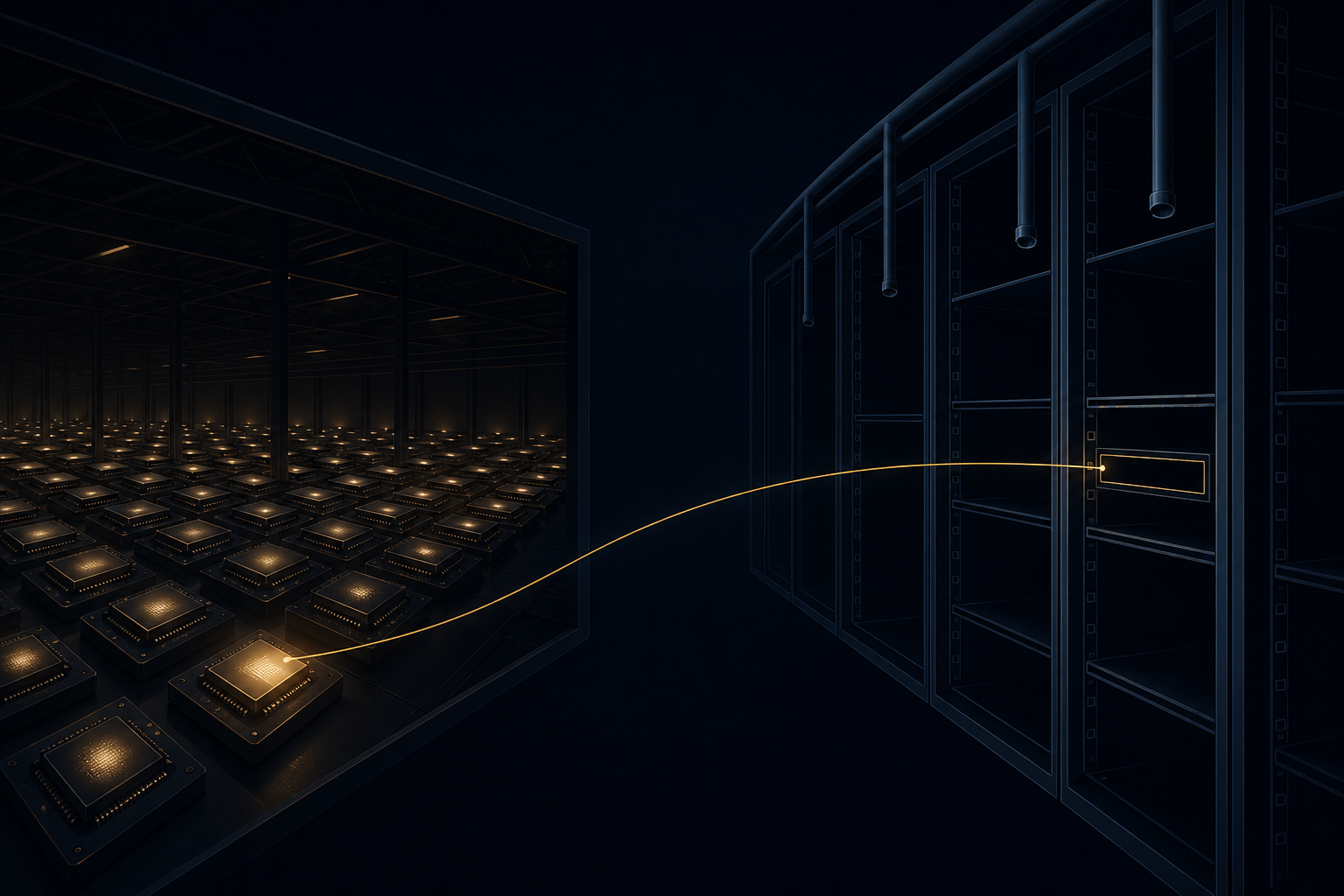
Project A ordered 50,000 H100s for Q3 2026 delivery. Paid hundreds of millions. The data center won't be operational until Q2 2027 — the utility can't deliver the grid connection in time. Project B has an operational data center, paying inference customers, and a Q1 2027 slot in Nvidia's allocation queue — 14th in line. Project A can't sell its GPUs to Project B because Nvidia's contract prohibits resale. The chips will sit in a warehouse for nine months, burning depreciation on hardware with a 3-4 year useful life (Uptime Institute, 2026), while identical silicon in an identical rack configuration would be generating revenue eight miles away.
The money is already spent. The shortage persists. The economics are irrational — but entirely rational for Nvidia, which books the revenue at allocation and has no incentive to facilitate a secondary market that would reveal the actual clearing price for its chips.
What Aviation Figured Out
An airline orders a 787 in 2020 for delivery in 2024. By 2024, the route economics shifted. The aircraft is worth $250 million. It doesn't sit in a hangar.
A lessor — AerCap, Avolon, SMBC Aviation Capital — buys the delivery position. The original airline gets paid for the slot it can't use. The lessor places the aircraft with another airline that needs capacity now. Boeing delivered the same aircraft. Boeing got paid. The lessor earns the spread. The queue cleared itself without the manufacturer doing anything.
Lessors now own roughly half the global airline fleet. The secondary market is not an edge case. It's the mechanism that makes the primary market liquid. AerCap alone manages over 1,700 aircraft across 300 customers — the model scales because ownership and operation are independent variables (AerCap, 2026).
GPU contracts don't allow this. But they don't need to. The same economic logic can be achieved without ever transferring ownership.
The Mutual Infrastructure Model
Step one: Colocation, not delivery.
Project A takes delivery of its 50,000 H100s — legally, to its own account, at Project B's operational facility. Nvidia's contract prohibits resale of the GPUs. It says nothing about where Project A installs them. A standard colocation agreement for rack space, power, and cooling is not a hardware transfer. Nvidia cannot block it without arguing that cloud computing itself constitutes an unauthorized resale.
Step two: Compute leaseback, not GPU rental.
Project A sells compute capacity to Project B by the GPU-hour. Not hardware. Not allocation rights. Compute services. Project B pays an operating expense. Project A earns revenue from day one of delivery. The GPUs that would have sat in a warehouse are generating cash during the exact window they would have been idle. The depreciation clock still runs, but at least it's producing income.
Step three: The mutual infrastructure agreement.
This is where the model becomes self-sustaining. Project B's own GPU allocation arrives six months later — 50,000 B200s. Project B's next building won't be ready for nine months. Those GPUs get installed in Project A's new data center, now operational. The arrangement reverses. Project A runs Project B's hardware. Project B sells compute back to Project A. Neither party ever has silicon in a warehouse. Neither party ever faces a migration.
The scheduling layer doesn't care which building the GPU sits in. Workloads route to available capacity across both facilities. Location is an accounting detail. The compute pool is the product. The hardware owner is the financing vehicle.
The Exit
If the partnership dissolves, nobody moves anything.
Project A turns off the clusters running Project B's workloads in Project A's building. Project B turns off the clusters running Project A's workloads in Project B's building. The GPUs go idle until reassigned. The physical hardware stays in the racks it was already in. The migration cost is zero. The only thing that moves is the billing.
Why This Matters Beyond Two Companies
The hyperscalers already do this internally across their own availability zones and regions. Google runs workloads on hardware it owns in buildings it leases from a colocation provider who also hosts Microsoft. The corporate boundary is already porous at the infrastructure layer. The mutual infrastructure model just extends the same logic across balance sheets.
The AI infrastructure build-out is projected to deploy 40-50 GW of new data center capacity by end of 2026. Utilities can deliver maybe 20-25 GW. Roughly half the GPUs ordered this year will arrive before the buildings they're destined for can be powered on. That's not a forecast. It's the gap between transformer manufacturing capacity and AI industry demand projections (McKinsey, 2026).
Every GPU in a warehouse during that gap is an asset that could be generating revenue. Every GPU generating revenue is an asset that can be financed. Every financed asset can fund the next pre-order. The queue doesn't clear by waiting. It clears by making ownership and operation independent variables.
The Objections
"Nvidia won't allow this."
Nvidia's contract restricts transfer of ownership — not location of installation, not sale of compute services. Cloud providers have been selling GPU compute by the hour for a decade without anyone arguing it constitutes a hardware transfer. The colocation-plus-leaseback structure uses the same legal architecture at smaller scale. If Nvidia tries to block it, they're arguing that EC2 is an unauthorized resale of Intel silicon. That's not a legal argument they want to make, and it's not one they'd win.
"The economics don't work because H100 prices are falling."
Project A is probably underwater on its pre-order pricing relative to current spot. The leaseback doesn't fix that. It stops the bleeding. Revenue starting at delivery is categorically better than revenue starting nine months later with nine months of accumulated depreciation. Even if the leaseback rate is below Project A's fully-loaded cost per GPU-hour, the alternative is zero revenue and full depreciation. Negative cash flow is worse than below-target cash flow.
"This requires trust between competitors."
Yes. So does every interconnection agreement, every peering arrangement, every shared fiber build. The industry has standard contracts for colocation, for service levels, for data isolation, for exit provisions. This is not new law. It's a standard leaseback with a colocation rider.
The First Mover
The first pair of companies to structure a mutual infrastructure agreement — a well-capitalized GPU owner with a delayed facility, and an operational data center operator stuck deep in the allocation queue — captures a pricing advantage that doesn't come back. The delta between warehouse depreciation and leaseback revenue is the cost of doing nothing. The window closes when the first bankruptcy court forces a liquidation and GPUs hit the market at creditor pricing.
Aviation learned this lesson in the 1980s when the lessors ate the manufacturers' lunch. GPUs are still in the era where the manufacturer controls the queue. That era ends. The only question is whether it ends through structured finance or through bankruptcy auctions. The companies that build the mutual infrastructure model first get to set the terms.