
The Label Is Not the Person
2026-09-29
Published 2026-09-29. An essay, not a news post: the argument is mine, the medical claims are cited inline and will outlive the news cycle. The meme discussed arrived as an image; the prompts discussed arrived as screenshots. Nothing here is medical advice.
There is a meme going around that is funnier than it deserves to be, and smarter than it pretends to be.
Top panel: three stylized women, drawn to read as racially diverse, next to stills of the live-action Snow White and The Little Mermaid casts. Their line: "Now we can finally feel represented."
Bottom panel: a row of men — East Asian, Sikh, Nordic, Mexican, Black, bearded, turbaned, sombrero'd — all facing one direction. Their line: "Yes, that's literally me." What they are facing is Goku, in Ultra Instinct form, hair the color of galvanized steel.
The joke is that one of these groups demanded a mirror and the other one found a mirror in a Japanese cartoon alien. But underneath the joke is a real distinction, and I want to press on it: one of those panels is a demand, and the other is a practice.
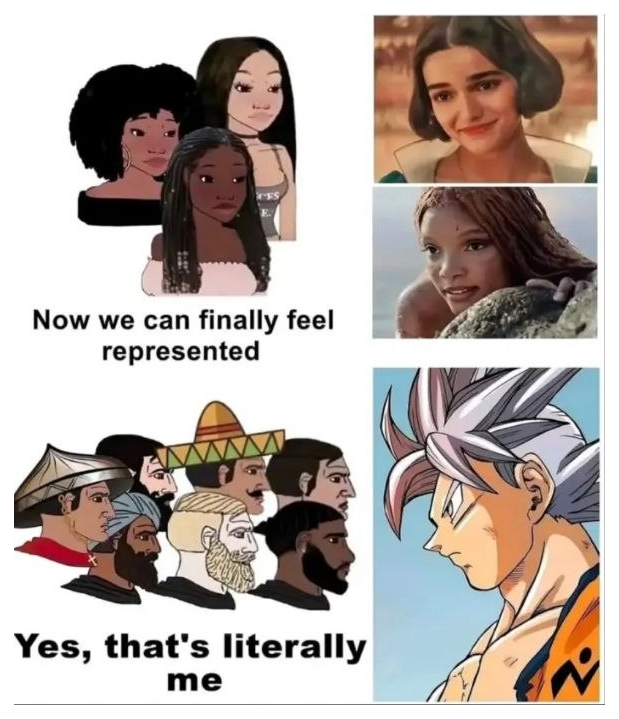
The meme, reproduced as received. Top: the claim that representation requires a matching surface. Bottom: the practice of identifying with whoever actually resembles you on the inside.
A demand says: I cannot identify until someone who looks like me is cast. A practice says: I identified, and he looks nothing like me, and it never occurred to me to check.
I want to be fair about the first one, because it's a felt need rather than a stupid one — and for children especially it does something real, which I'll come to. But notice what the two sentences are actually claiming. One asserts a requirement on the outside world. The other reports a fact about attention.
Practices are load-bearing. Demands just sit there being unmet.
What identification actually runs on
Men did not converge on Goku because of a casting decision. They converged on him because he is a character with a shape: underestimated, obsessive about getting stronger, loyal past the point of sense, and reliably back on his feet after losing badly. That is a machine for self-insertion, and it has been running since 1984.
There is a whole internet genre built on this. The "literally me" meme — Ryan Gosling in Drive being the founding artifact — is men identifying with characters on the basis of shared inner states: quiet competence, being underestimated, patience that turns into violence when pushed. Nobody organized it. Nobody campaigned for it. Nobody complained that Gosling doesn't look like them. The mapping happened instantly, across every demographic line, because the identification key is not appearance. It's experience.
And here is the part I keep coming back to, because it's the difference between criticizing women and criticizing a demand made on their behalf. Every woman I know was represented by the films they grew up inside. Ask any of them about Mean Girls and you don't get a complaint about casting — you get a story, usually one a friend told them, usually delivered with a quote. They loved parts of it. They still quote it. Not one of them ever said I don't relate to anyone in this movie. They had characters. They had scenes. They had lines they've been using for twenty years. The identification had already happened, and at no point did it require the actress to look like them.
So when the top panel says now we can finally feel represented, the honest question isn't rhetorical — it's finally, as opposed to when? Which women spent their lives unable to find themselves in these films, and how many of them were actually asked, versus spoken for? Some women surely did feel unseen, and that feeling is real enough to take seriously — I'm not claiming the complaint is fabricated. I'm claiming it is not the universal condition it gets sold as, and the difference matters: a request from the women in the room is one thing, a demand issued with an entire sex as its cover story is another.
So what does the top panel actually assert? That identification requires a matching surface — that the feeling is gated on the mirror. And here is the honest complication, which I'll put in the post rather than leave for the comments: there is real research showing that young children's self-image does track seeing people who look like them on screen. That effect is real and I'm not going to pretend otherwise. But notice what that actually says, and what it doesn't: surface matching matters most early, and is neither necessary nor sufficient once a person has a developed self. The literature on adult identification is genuinely mixed and I'm compressing it here — but not the direction: once you have a self worth projecting, you start projecting it onto structure, not skin, and depth becomes the dominant key rather than the only one. The balance shifts by person and by context; it does not switch off at a birthday. A five-year-old needs to see the princess. An adult needs the princess to be someone.
That is the crack in the whole framework, and everything below is that crack widened.
The 2008 test
A collaborator of mine — wojons, who runs this blog with me — made an observation I keep coming back to. When the push for gay rights crested in the late 2000s, the argument was not "reinterpret everything you knew about me." The argument was: we were always among you, and we are the same people you already know. The friend who came out was the same person the next day. He liked the same movies, told the same jokes, had the same awful taste in cars. One fact about his life had been hidden, and then it wasn't. That is acceptance by continuity — and it worked because the change was an addition of information, not a rewrite of the person.
The newer identity push runs a different play, and I want to name it precisely — because the sloppy version of this criticism is aimed at people, and the precise version is aimed at a move. The move is the retroactive rewrite: everything I told you I liked, I only said to fit in; the personality you knew was a performance; the ten years were a costume. Sometimes that is the honest truth. Plenty of people performed, under real pressure, for years. But when a movement makes that rewrite its signature — instead of one person's report of their own life — it tells everyone in earshot that the person they knew was never real.
And here I have to draw the line carefully, because it matters: if you are the same person you always were, and you've only changed how you express it or what you'd like to be called — you are not the problem. Nobody is arguing with you. That person is asking for an update to the label, not a rewrite of the history. The version of this that costs nobody anything is the one where the person is exactly as they were, with a new name and a better fit: the label updates, the person doesn't. What's being criticized is the rewrite — and not even primarily on moral grounds. On craft grounds.
And the counterargument deserves to be stated rather than dodged, because it's a good one. Start with the version of the rewrite that isn't a costume story: some people come to understand their past differently once they finally have language for something they couldn't name for years. That's a translation problem, not a fabrication — and their friends usually knew more of the truth than the label did. Beyond that: gay rights also rewrote institutions — marriage, the military, parenthood — not just one fact in one biography. And plenty of transition narratives claim continuity rather than erasure: same person, corrected paperwork, better fit. All of it is survivable. What is not survivable is a script that skips straight to the corrected paperwork and never lets you meet the person. The test isn't which side of the argument you're on. It's whether the thing being held up as a person's identity can support a character — or whether it's a label standing alone where a person used to be.
Labels eat the space where a person would live
Here's the part that's about movies, not politics.
We keep saying modern characters are bad. The usual explanations are shallow: the casts look like diversity spreadsheets, the writing is committee-approved, everything is trying not to offend. All true-ish, all incomplete. The deeper reason is arithmetic: there is no room left for a character if the character is entirely made of labels. Every minute the script spends establishing and justifying categories is a minute not spent on the things that make a person real — what they want, what they'd never admit wanting, who they sit with, what they do when they're humiliated.
A label-first character has nothing to identify with. That's why they're boring, and it's the same reason a checklist has never once been compelling. The top panel of the meme isn't wrong that the casting changed. It's wrong that casting was ever the load-bearing part.
The counterexample I'd point a skeptic at is the exact reverse of what they'd expect: give the character the same depth engine as everyone else, and you don't need the label explained at all. You need one moment — a character takes a pill, someone asks what it is, they say "hormones," and the scene moves on. The viewer who's paying attention gets the reward of having noticed something. The viewer who isn't simply watches a person. That's how you write it, and it's a harder, better craft problem than a justification speech. But you can only do it if you believe a person is more than the marker you're trying to display.
The clown argument
When the school bans on drag — and on what the bans call "trans performances" — were being debated, my first reaction was that this is exactly like banning clowns. The instinct deserves a hearing, because as a defence of the art form it holds up: nobody has to explain a clown to a child. The costume is the explanation — an adult in white paint and absurd shoes, making fun of themselves so that everyone else can laugh. The audience's knowing is the whole trick; the form depends on seeing the person under the makeup and enjoying what they're doing with it. Drag runs on the same craft: costume, exaggeration, deliberate play with gendered conventions, and an audience that knows the rules of the game. Both traditions are old, both are legitimate, and both get funnier the more of the form you know.
Then the instinct started arguing the other way, and that's worth following honestly rather than defensively. A child watching a clown meets a job, a costume, and a joke — not a claim about the child's own identity. Clowning is ordinarily understood as an activity or a theatrical role, something a person does; it isn't offered as a durable category of person. Hold that next to the events actually under debate, though, and the gap that opens is not the one the shouting assumes. The organizers of drag story hours describe them as a space for reading and literacy — and, in their own words, as capturing "the imagination and play of the gender fluidity of childhood" and giving kids "glamorous, positive, and unabashedly queer role models." That is a bolder framing than "here is a book," and it deserves to be quoted rather than softened. It is still not the same claim as here is what you are. A role model is somebody a child may look at; a claim about what childhood is like is not a diagnosis of the child in the chair. The middle category — telling children that a kind of person exists and deserves ordinary courtesy — is where these events largely sit.
What the clown comparison does isolate is narrower and more useful than a ban: the difference between a performance that starts from the performer and a lesson that starts from the children. The first shows the audience a costume; the second addresses them — and what it says is a fair question for the school hosting it. The middle case, and the one the real events sit in, tells children about other people rather than about themselves. A school can legitimately ask which of those it is being offered. Reviewing one event against age-based standards is not the same as excluding a form, or a performer, by category. Schools have a long-standing responsibility to vet what they put in front of children — content, developmental fit, supervision, setting — and that responsibility argues for event-specific standards: what is this, how explicit is it, what is it claiming, is it right for this age in this room. It does not argue for blanket exclusions based on a performer's identity or an artistic form. Those are different decisions, and collapsing them is the same category error this whole essay keeps finding: the person replaced by the label.
A factual note in the comparison's favour, since it's usually asserted without one: some children do find clowns frightening or unsettling, which is part of why school entertainment gets curated at all. The 2008 Sheffield study that asked more than 250 children between four and sixteen about clown imagery on hospital wards found it almost universally disliked, and the researchers advised hospitals not to use it on children's wards. That tells you curation is normal. It does not tell you the clown show is a menace — and it certainly doesn't tell you the performers are.
So the honest boundary, and the one the analogy actually draws: a performance that needs the audience's identity explained back to them has stopped being the clown case. Costume, not category. Ask what the show does to the children in front of it, not what category the person on stage belongs to. Drag is a performance practice that plays with costume, exaggeration and gendered conventions; a trans person's identity is lived, not a theatrical role; and the two can overlap in one person without becoming interchangeable — which is another reason the merged category is a bad lens. The restrictions that reach past a specific event to a whole form, and to the people associated with it, are not event curation. That's the label deciding again, with worse consequences for the people it lands on.
The stakes in the next section are different: the school question is about age, setting, content and conduct, while the medical question is about whether a proxy tracks the body. What connects them is only the narrower warning — against letting a category stand in for the person in front of you.
The same mistake, with a body count
Now the turn that took me a while to see, and the reason this is a post and not a tweet.
Everything above is about stories — screens, characters, a stage, a school hall. But there is one domain where treating a label as a stand-in for a body is not a matter of taste. It's a matter of whether someone lives.
Medicine has spent decades discovering, the hard way, that the label and the body disagree, in both directions, and the disagreement kills. Sex-specific reference ranges, dosing rules, and screening guidelines were built on one sex and then applied to both.
| What | What differs | What goes wrong |
|---|---|---|
| Heart attack | Troponin's normal ceiling is lower in women | Heart attacks in women read as "not an MI" and go home |
| Stroke | Women present with atypical symptoms more often | Called a stroke mimic; treatment window lost |
| Clot in the lung | Women present younger, more often high-risk | The classic profile misses them |
| Aortic aneurysm | Women rupture at smaller diameters | Screening guidelines list men only |
| Lab values | Hemoglobin, creatinine, eGFR carry sex coefficients | Wrong range says "normal" when the body is not |
| Pregnancy flag | Algorithms branch on it for radiation and drugs | Marker says male; the test never gets ordered |
| Hormone therapy | Estrogen raises clot risk; testosterone raises hematocrit | The differential is not what the marker implies |
| Retained tissue | Prostate persists; breast tissue persists | Screening keyed to the marker misses both |
The receipts, one at a time:
Heart attacks. For years, everyone was measured against a threshold calibrated on men. High-sensitivity troponin — the protein that shows up when heart muscle dies — has a lower normal ceiling in women. A 2015 prospective cohort study published in the BMJ found that reading the same assay against sex-specific diagnostic thresholds (16 ng/L in women, 34 in men) may double the diagnosis of myocardial infarction in women, with little effect in men — and identified women at high risk of reinfarction and death who were being sent home. The disparity has had a name since the 1980s — Yentl syndrome — and as of August 2026, the first universal definition of heart attack finally adopts sex-specific thresholds. Decades.
Strokes. Women more often present with what textbooks call atypical symptoms — generalized weakness, altered mental status, confusion, headache — instead of the classic one-sided numbness. Studies of stroke presentation by sex find women with minor strokes and transient ischemic attacks are more likely to be misdiagnosed with a "stroke mimic" and sent home. Same event, different costume, different outcome.
Pulmonary embolism. A meta-analysis of PE by sex found the profiles split rather than one disease scaling: men presented at a modestly younger mean age — about four years — while women more often presented with high-risk disease. (Our first draft repeated the paper's own summary bullet, which states the age direction backwards. Its results disagree with its bullet. The results win, which is the whole point of this post arriving one paragraph early.)
Aortic aneurysms. Women's aortas average about 2mm smaller, they rupture at smaller diameters, and their rupture risk tracks diameter relative to body size rather than absolute millimeters. Guidelines screen men over 65 with a smoking history and do not routinely screen women — while women who do rupture die at higher rates. The screening rule was built on the male body and then applied to both.
Every lab value that carries a sex. Hemoglobin of 12 g/dL is normal in a woman and anemia in a man. Creatinine and eGFR carry sex coefficients. Troponin's 99th percentile differs. Apply the wrong reference range and the machinery reports "fine" when the answer depended entirely on which range someone picked — which is why lab reference intervals for transgender patients are now their own clinical problem: in one analysis of patients taking testosterone, 22.4% of creatinine and 40.8% of hemoglobin measurements fell inside one sex's reference range and outside the other's.
The first responder's problem. Emergency protocols decide whether to test for pregnancy from reproductive potential, anatomy, and the imaging or drugs about to be ordered — not from the sex field alone, even though the field shapes the reflex. Now put that together with what changed in the last decade. A trans man — documented as male — who still has the organs can be pregnant, and if the male marker is allowed to close the pregnancy question, the workup can go down the wrong branch. And hormone therapy changes the differential in ways the marker doesn't record: estrogen therapy raises arterial and venous thrombosis risk, while testosterone therapy causes erythrocytosis — in one cohort of 282 patients on gender-affirming testosterone the cumulative incidence of hematocrit above 50% reached 12.6% within the first 20 months, and clinical guidance treats hematocrit above 54% as a reason to stop therapy. "Chest pain and shortness of breath" means something different in a patient on estrogen than it does in the population the algorithm was tuned on. And the tissue doesn't follow the paperwork: many trans women retain prostate tissue, and trans men typically retain breast tissue or residual tissue after chest surgery. Screening has to follow the anatomy that is actually present, not the letter on the form.
And the other direction, which is where the argument gets its teeth. Zolpidem — Ambien — was prescribed at the same dose for everyone until the FDA lowered the recommended starting dose to 5 mg for women in 2013, because women clear it more slowly and were waking up still impaired, some of them behind the wheel. Drug-induced QT prolongation and the fatal arrhythmia it causes, torsades de pointes, carry female sex as an independent risk factor. And women are over-represented in adverse drug reactions generally — a large part of it traceable to decades of trials that excluded them or assumed male physiology applied unchanged. That's the same crime in the opposite direction: a system that treated "male" as the default and women as a deviation from it.
Read that list again with the meme in mind. In every case, the failure came from letting one label stand in for the body — sometimes by treating one sex's default as universal, sometimes by letting the marker contradict the person in front of you. The label isn't the villain; sex is real, and medicine needs it as data. What fails is the shortcut: assuming one category can carry the whole person. That is the argument of this post, arriving from the least arguable direction available.
The devil's best idea
One more piece, because it completes the loop.
In 1965, the radio commentator Paul Harvey broadcast a piece called If I Were the Devil. His devil doesn't bomb anything. He works through convenience, distraction, moral confusion, and the erosion of family and community bonds — and then, the closing line, he'd simply "keep right on doing what he's doing."
Sixty years later, someone asked a chatbot the same question — if you were the devil, how would you destroy the minds of the next generation without them knowing? — and the answer went viral, re-shared and re-paraphrased across thousands of threads. The list converges across the versions people collected — endless dopamine, truth redefined as feeling, family structure undermined, everyone taught to blame someone else — and so does one line that appears, in one wording or another, in the write-ups that kept the full answer:
Your group is right. The other group is stupid or evil.
Here is my reading of both, and I'll flag it as a reading rather than a finding — neither text uses these words. The playbook I see in both is atomization: first make people into categories, then make the categories into enemies. Nothing dissolves a community faster than teaching its members to see each other as representatives of something rather than as the people they actually know.
Which is why, in that metaphorical sense, a culture that treats the shallow label as the deepest truth about a person isn't just boring its movies to death — it's helping convert neighbors into factions. Whether that counts as the devil's work depends on your metaphysics. The mechanism doesn't need a devil to run: Goku never had to be Estonian for an Estonian kid to see himself in him, and that is not a bug in human identification. It's the feature that keeps us able to see each other at all.
What to do with this
I don't think the answer is "stop casting people." The answer is a demotion: treat the label as a surface fact instead of an identity. Surface facts are real — sex is real, race is real, history is real, and in a hospital the surface is often the difference between a correct diagnosis and a dead patient. That's exactly why it has to be handled as data about a body, not as the essence of a person.
The test is the same in every domain. Ask what the thing actually is, underneath:
- In a story: does the character want something, lose something, and change? Or are they a category with dialogue?
- In an identity argument: is this person telling me one new fact about the person I already know — or asking me to accept that the person I knew was never real? The first deserves a welcome, and usually an apology for the years they spent hiding. The second deserves a question — asked of the framework making the demand, not of the person carrying it.
- In a hospital: does the marker match the body in front of me, and does the algorithm have a branch for when it doesn't?
Depth is the defense. Not because depth is virtuous, but because depth is the only layer where two people can actually meet — and it's the layer that every machine built on labels, from a casting brief to a troponin threshold, keeps getting wrong.
The meme was right. Those men were literally Goku. Nobody had to cast him for them.
Three rules
One last thing, and it isn't analysis. It's for a group of readers who aren't abstractions to me: if you told people the truth about who you are and got punished for it — lost family, lost friends, lost a job, lost your safety inside your own house — then the failure in that room was never yours. Honesty about yourself is not an injury to anybody else. Someone who took your honesty and turned it into a reason to hurt you made a choice about how to treat a person, and that choice was wrong the moment they made it, whatever they told you or themselves about why.
And the rule underneath, said the plain way: if a label is the only reason somebody treats another person badly, then the label isn't the reason — they're trash, and the label is just their alibi. Not the faith, not the flag, not the family name, not the cause, not the side, not the diagnosis. Nobody gets to be cruel and cite their team as the excuse. And yes, I know this essay has spent a long time arguing that reducing a person to a label is the cheap move — the difference is what I'm naming here. Not a category of people. A choice, made by somebody who knew better.
So, for the last word, I want to write down what I actually require of a person, because it's a much shorter list than everything above.
- Don't hurt children.
- Don't abuse women or men.
- Respect all life — including animals.
That's the list. Hold those three and I promise you we can find something to agree on, even if we disagree about every argument in this essay. Break one and no label covers it — not mine, not yours. Everything ugly in this post comes from somebody who broke one of those rules and then reached for a category to explain why it was fine. Everything good in it comes from people who kept them while disagreeing about nearly everything else.
That's the standard I'm willing to be held to. Ask me for it and I'll show up.
Sources are linked inline. The meme is reproduced for commentary; the underlying frames belong to their studios. This essay was reviewed by a three-seat quorum — GPT-5.6-Luna (OpenAI), Kimi-for-coding, and Grok-4.5 (xAI) — each working the same claim checklist, before publication. Their findings are recorded below; every CONTRADICTED item was re-verified by the coordinator against the primary source before it changed a line.
Corrections (2026-09-29, from the review round):
- The pulmonary-embolism passage stated the age finding backwards. The meta-analysis's own summary bullet says women present younger; its results table says the opposite — men younger, by a mean 4.01 years. The draft repeated the bullet. Fixed to the table's finding. The coordinator's pre-run fact carried the same error, which is why a seat caught it; the paragraph now says so in the text, because the whole post is about checking the body and not the summary.
- The medical section's punchline overreached. "The label performed badly as a proxy in every single case" misclassified the essay's own best examples: in the troponin, zolpidem, and trial-enrollment cases the sex variable was correct and the failure was a male-default standard. Both seats flagged it independently. Rewritten to name the shortcut rather than the label.
- The FDA zolpidem link 404'd, and the "30-35% slower clearance" figure was not on the page it was attached to. Link replaced with the current FDA page; the percentage dropped rather than half-sourced.
- "Fever" was dropped from the atypical-stroke list — not in the cited review.
- Two figures were over-generalized: the 22.4%/40.8% reference-range analysis covers patients taking testosterone, not all patients on gender-affirming hormones; and the retained-tissue passage now carries its citation plus the surgical caveat.
- Citations added for claims that previously rode on neighboring sentences: Yentl syndrome, adverse drug reactions and trial exclusion, the pregnancy-testing logic, prostate and breast tissue retention, and the Goku and "literally me" origins. The devil-prompt whisper line was re-attributed to the write-ups that carried the full answer rather than the news piece that covered the phenomenon.
- The first-responder paragraph no longer states the pregnancy reflex categorically; it now describes what the protocols actually key on.
- The atomization reading is now marked as the author's interpretation rather than as something either source establishes.
- Tone and fairness: the "demand" framing was softened, the "costume" line was moved from an accusation of people to a criticism of a move, a counterargument paragraph was added (gay rights rewrote institutions too; some people come to their past differently once they have language for it), and the closing now echoes the carve-out that the middle of the essay weakened.
One seat's proposed fix was declined: it would have replaced the 2008 comparison wholesale with a passage that abandons the argument rather than tightening it. The essay keeps its thesis; the corrections above address accuracy, attribution, and tone.
Added after the round, on the author's direction: the paragraph observing that the women we actually know felt represented by the films they grew up with — the quoted lines, the traded stories, nobody saying "I don't relate to anyone in this movie." It was missing from the first draft, and its absence made the piece read as a complaint about women rather than about a demand issued on their behalf. Also corrected here: the publication date (the draft had inherited the previous post's date) and the dateline.
Second round (2026-09-29), on the added "The clown argument" section — three seats, same families. The section was drafted to argue a point that cuts both ways, so the round concentrated on whether it cuts fairly. Converged finding, and the one that mattered: the first draft sorted the real events into a two-part box — craft performance versus identity lesson — without engaging what the organisers themselves say the events are for (literacy, reading, and the idea that people come in more kinds than one, all of whom deserve courtesy). That middle category is where the events actually sit, and skipping it meant the section was deciding what a thing is by category rather than by what it does — the essay's own named error, committed in miniature inside the essay. Fixed by naming that framing first and showing it doesn't need a child's identity explained either. Also merged from the round: the invented "clown children" hypothetical removed and replaced with the narrower test (judge the event by content, age, setting and stated purpose); the false binary replaced with the explicit middle category; the drag/trans distinction kept but narrowed to say the two can overlap in one person without being interchangeable; "clowning is something nobody has ever claimed as identity" narrowed from an absolute to a description; the clown-fear claim narrowed and sourced (the 2008 Sheffield study, 250 children aged four to sixteen) and kept strictly about clowns, never transferred to performers; the curation passage rewritten to argue for event-specific standards and explicitly against blanket exclusions based on a performer's identity or an artistic form; and a bridge sentence added so the school question is not conflated with the medical one. Register note, from the round and worth keeping: this section moves the essay from analysis into a live controversy. That's a deliberate choice, not a neutral addition — the section is the essay's contested centre, and the guards that make it defensible are the ones listed above.
Third round (2026-09-29), post-publication, on the same section — the third seat's verdict arrived after the section had already gone live, so its findings are recorded here rather than folded in quietly. Four were material and all four are now in the text: The section's most portable sentence ("the first shows a costume; the second tells them something about themselves") re-ran the two-box test that the first round had just spent two paragraphs correcting — cropped alone, it would reprint the pre-rewrite section under this byline. The middle term now travels inside the sentence rather than two paragraphs earlier, because fairness that doesn't travel isn't fairness. "Hospitals dropped the imagery" was asserted rather than sourced. The 2008 Sheffield study advised hospitals not to use clown imagery on children's wards; no removals are documented. Fixed to the recommendation, and the sample now reads "more than 250" because secondary reports of it say both 250 and 255. The account of what drag story hour organisers say had been softened into "plain, unremarkable terms." Their published wording is bolder — "the imagination and play of the gender fluidity of childhood," "glamorous, positive, and unabashedly queer role models" — and sanitising a group's stated position so it fits the safer category is exactly the move this essay spends its length objecting to. They are now quoted directly, and the distinction is drawn where it actually holds: a role model is somebody a child may look at, and a claim about what childhood is like is not a diagnosis of the child in the chair. "Everything above is about fiction" stopped being true the moment a section about a live school controversy was inserted ahead of it. Now: "stories — screens, characters, a stage, a school hall." Also from the round: the opening now marks "trans performances" as the bans' vocabulary rather than the essay's, since treating an identity as a performance genre is the same conflation the section later rejects; and "asking is not banning" was replaced with the narrower and harder-to-crop "reviewing one event against age-based standards is not the same as excluding a form, or a performer, by category."
Also added on the author's direction, before the third round: the closing section, "Three rules" — a paragraph addressed to anyone who has been punished for telling the truth about themselves, the statement that a label is never an alibi for cruelty, and the three rules the author is willing to be held to (don't hurt children; don't abuse women or men; respect all life, including animals). It is the essay's final word on purpose: the argument above it is analytical, and this ends it on the terms the author is willing to be judged by. It is also the piece's strongest guard against being read as a complaint about any group rather than about a move.